How to Track Workouts and Measure Strength Progress
Learn what to record in a workout log, how to compare sessions fairly, and how to use top weight, estimated 1RM, and volume to spot trends.
Your workout log should answer one question: am I doing more than I could before? You do not need a diary or a complicated spreadsheet. You need a clean record of what actually happened.
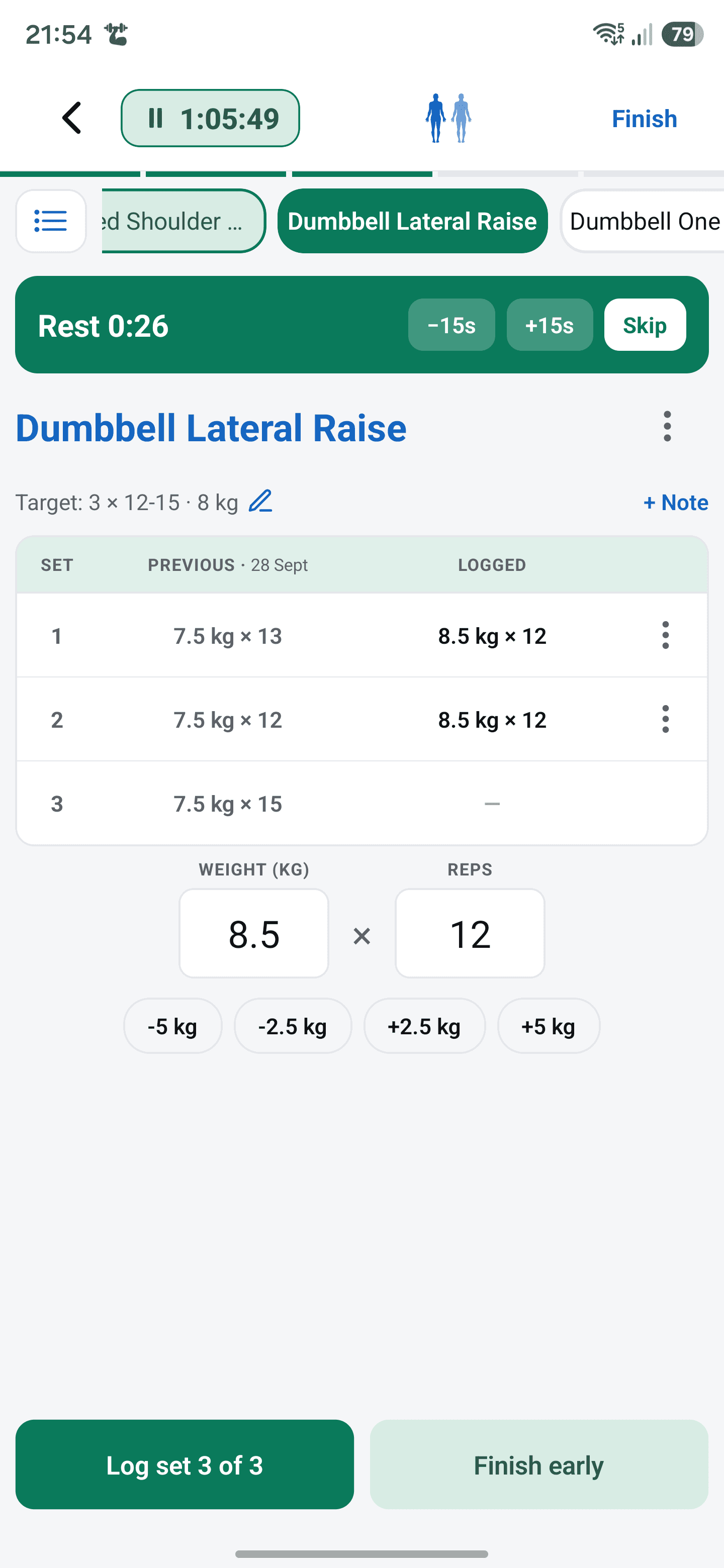
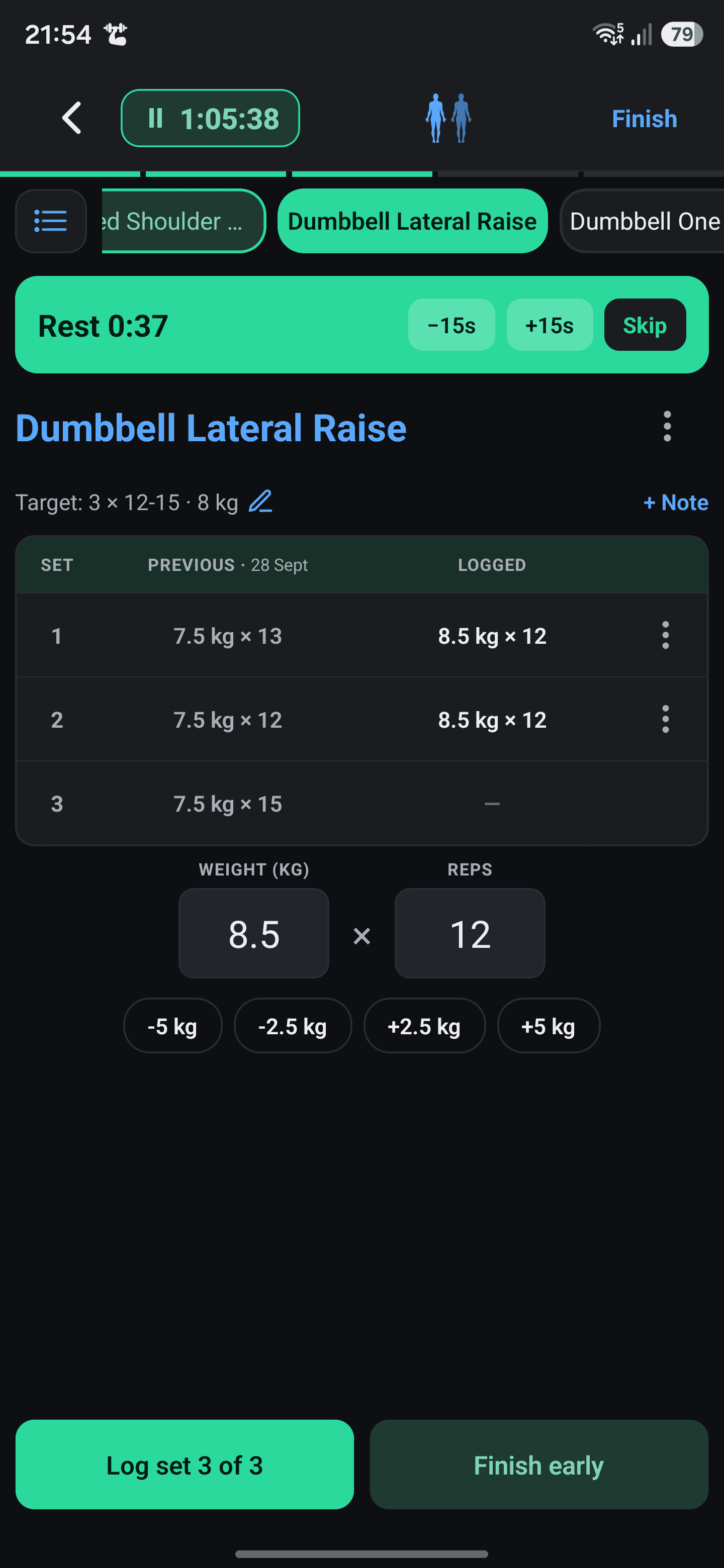
Record the movement, load, and reps for every working set. Then compare the same movement over several sessions. More reps at the same load, more load for similar reps, or a rising estimated 1RM are all useful signals. One great workout is a data point; a pattern is progress.
What to record in every workout
Your log only needs enough detail to reconstruct the session later. Start with these five items:
- Exercise and variation. “Bench press” is useful; “paused barbell bench press” is better when the pause matters.
- Working sets. Keep warm-ups separate from the sets you use to judge progress. You can label them, put them in a different column, or simply start your comparison with the first working set.
- Load and unit. Record kilograms or pounds consistently, including assistance or added weight where relevant.
- Repetitions completed. Record each set instead of replacing it with an average.
- Useful context. Note a changed machine, attachment, seat position, range of motion, or technique only when it affects the comparison.
If you are unsure whether to enter one dumbbell or both, or what to include in a machine entry, read How to Log Barbell, Dumbbell, and Machine Weights for equipment-specific examples.
Minimum useful entry
Barbell bench press
60 kg × 8, 8, 7
You do not need a long diary entry after every exercise. Add context when something changed; otherwise, a clean set-by-set record is usually easier to maintain and compare.
Make workout comparisons fair
A heavier number is only meaningful when the comparison is close enough. A barbell bench press, a chest-press machine, and an incline dumbbell press are different movements. Even two machines with the same label may use different leverages or weight stacks.
Before comparing two sessions, ask:
- Was it the same exercise variation and equipment?
- Did I use the same weight unit?
- Was my technique and range of motion reasonably similar?
- Did I complete the compared sets with roughly similar effort?
- Am I comparing working sets with working sets?
- Did an important setup detail change?
These details matter because resistance-training programs contain several distinct variables, including load, volume, frequency, exercise order, and range of motion. The current American College of Sports Medicine position stand treats them separately rather than as one interchangeable measure. A good log makes the changed variable visible.
What strength progress can look like
Strength progress does not have to mean setting a lifetime record in every workout. Under comparable conditions—including similar technique and effort—the following patterns can indicate better exercise performance:
- More reps at the same load: 60 kg × 9 after previously completing 60 kg × 8.
- More load for similar reps: 62.5 kg × 8 after previously completing 60 kg × 8.
- A higher estimated 1RM trend: several comparable sessions move upward, even without a maximal attempt.
- Repeatable performance: a result appears across more than one session instead of as an isolated unusually good day.
Understand top weight, estimated 1RM, and volume
These three common metrics answer different questions. It is normal for them to move in different directions.
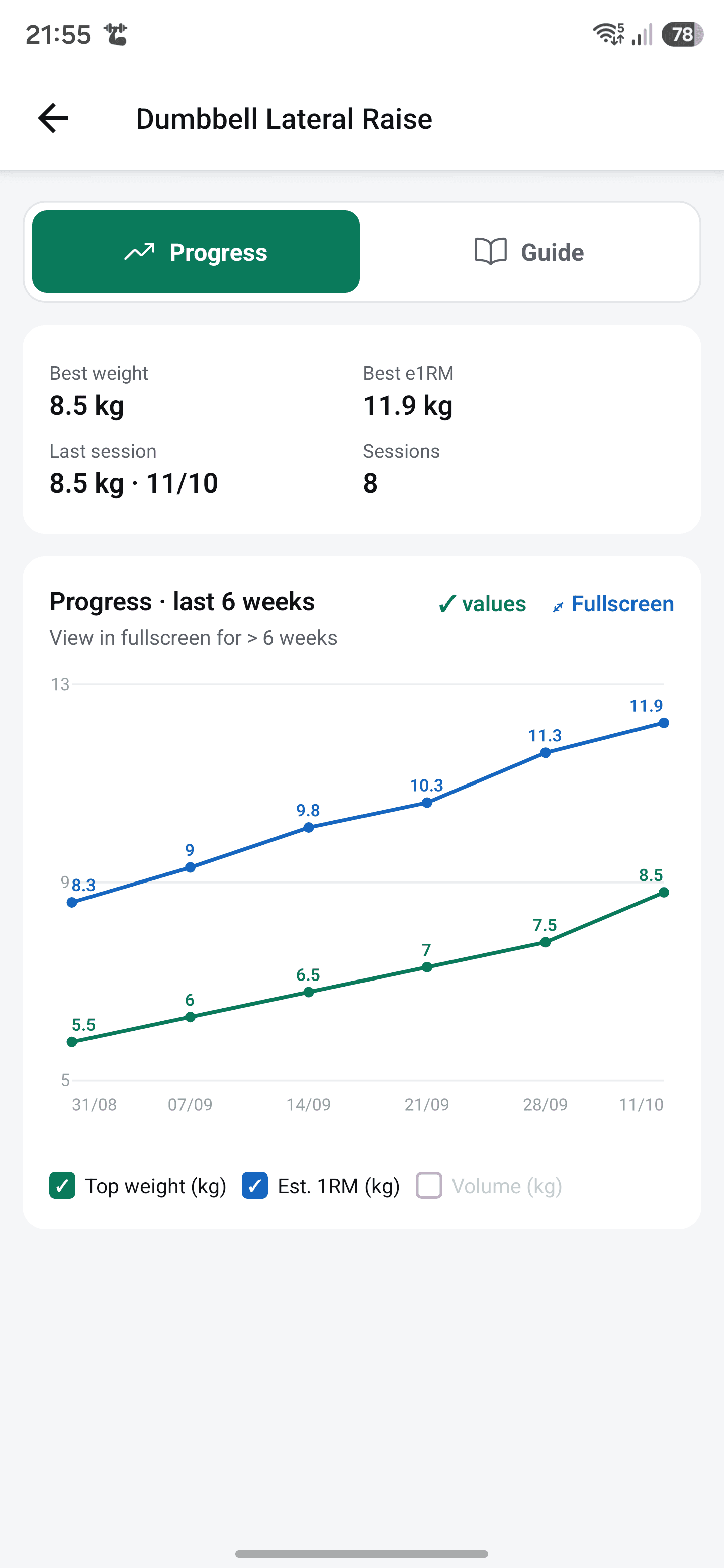
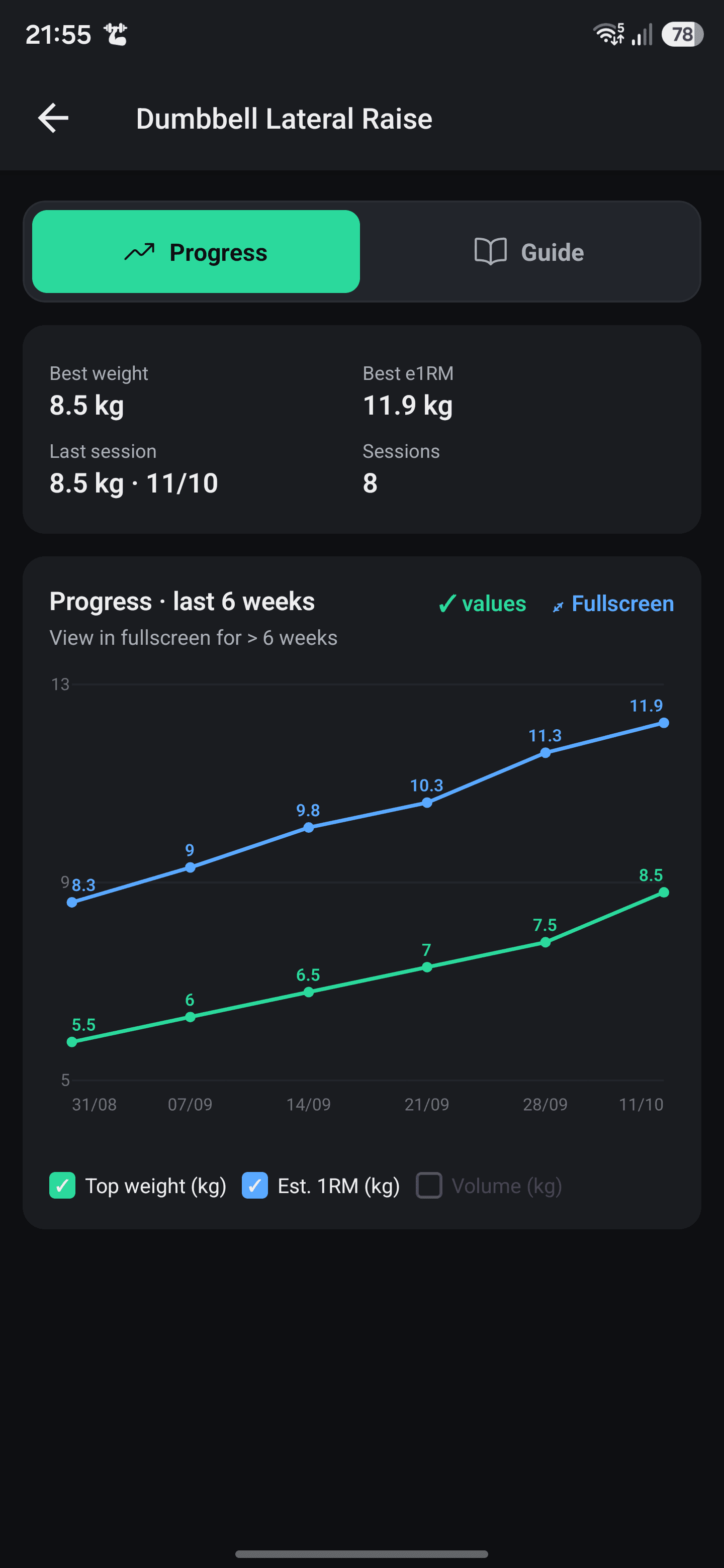
01 · Top weight
What was the heaviest load?
Top weight is the heaviest load among the exercise's working sets in a session. It does not account for how many reps you completed.
02 · Estimated 1RM
What is the formula-based strength estimate?
One common formula is the Epley estimate: load × (1 + reps ÷ 30). Apply it consistently to your best working set. It is a trend estimate, not a measured maximum, and sets completed at very different effort levels are less useful to compare.
03 · Volume
How much load was accumulated?
Add load × reps across all working sets. The total summarizes workload; it does not measure how much strength or muscle you gained.
Estimated 1RM is most useful when exercise, technique, and effort stay reasonably consistent. A 2025 cross-validation of 18 prediction equations found that prediction accuracy differed by formula and exercise. That is why “estimated” matters: use the number as a trend, not as a claim about the exact maximum you could lift today.
Volume needs the same caution. Research has found different strength outcomes even when volume load was matched. Equal totals do not make two training programs equivalent. See the systematic review of volume-matched resistance training.
Worked example: three bench-press sessions
This fictional example assumes the same exercise, comparable working sets, and similar technique and effort. The figures are illustrative, not a recommendation for what you should lift.
| Session | Working sets | Top weight | Est. 1RM | Volume |
|---|---|---|---|---|
| A | 60 kg × 8, 8, 7 | 60 kg | 76.0 kg | 1,380 kg |
| B | 60 kg × 9, 8, 8 | 60 kg | 78.0 kg | 1,500 kg |
| C | 62.5 kg × 8, 7, 6 | 62.5 kg | 79.2 kg | 1,313 kg |
The volume calculations are:
A: 60 × (8 + 8 + 7) = 1,380 kg
B: 60 × (9 + 8 + 8) = 1,500 kg
C: 62.5 × (8 + 7 + 6) = 1,312.5 kg → 1,313 kg displayed
Session B contains more reps and more volume than A at the same top weight. Session C has the highest top weight and estimated 1RM, but lower volume because it contains fewer total reps. The metrics are not contradicting one another—they are describing different parts of the workout.
That is not a contradiction. Session C trades total reps for a heavier load and the highest estimated 1RM.
Taken together, the example would suggest an upward performance trend. It still would not justify saying that strength increased by the same percentage as volume, or that every future session must improve.
How to review your workout log
- Choose one exercise. Do not mix unlike movements into one strength comparison.
- Look at several recent exposures. Three to six is a practical viewing window, not a scientific threshold.
- Compare like with like. Check the variation, equipment, units, and set details.
- Ask one clear question. Did reps at this load rise? Did top weight rise for similar reps? Is estimated 1RM trending up?
- Read the context. One unusually strong or weak session should not outweigh the broader pattern.
Common workout-logging mistakes
- Combining different variations: keep materially different movements separate so their histories remain meaningful.
- Recording the plan instead of the result: log the reps and load you completed, even when they differ from the target.
- Mixing kilograms and pounds: use the correct unit and convert old entries before comparing them.
- Treating volume as a score: a larger total is not automatically a better workout.
- Reacting to one session: use repeated comparable results before calling something a trend.
- Writing too much: notes are most useful when they explain a change that the set numbers cannot.
Choose a tracking method you will keep using
The best tool is the one you can update between sets without breaking your focus. All three options below can work; consistency matters more than format.
Notebook
Fast, distraction-free, and easy to carry. Best if you enjoy reviewing pages by hand.
Spreadsheet
Flexible and excellent for custom charts. Best if you do not mind setting up your own system.
Workout app
Convenient for set-by-set entry and automatic history. Best if speed and built-in trends matter.
TrrackFit lets you record each working set, review previous results, and follow changes in load, reps, estimated 1RM, and volume over time.
If you want a clear plan to go alongside your log, read How to Build a Reusable Workout Routine for a template example and a way to keep planned targets separate from results.
Sources
- Currier BS, D'Souza AC, Fiatarone Singh MA, et al. “American College of Sports Medicine Position Stand. Resistance Training Prescription for Muscle Function, Hypertrophy, and Physical Performance in Healthy Adults: An Overview of Reviews.” Medicine & Science in Sports & Exercise. 2026;58(4):851–872. Read the open-access article.
- Roberts TD, Smith RW, Arnett JE, et al. “Cross-Validation of Equations for Estimating 1 Repetition Maximum From Repetitions to Failure for the Bench Press and Leg Extension.” Journal of Strength and Conditioning Research. 2025;39(2):e96–e105. View on PubMed.
- Carvalho L, Junior RM, Barreira J, et al. “Muscle Hypertrophy and Strength Gains After Resistance Training With Different Volume-Matched Loads: A Systematic Review and Meta-analysis.” Applied Physiology, Nutrition, and Metabolism. 2022;47(4):357–368. View on PubMed.